
How Paper Tickets Add Work and Delay Billing at Landfills
A truck leaves, but the paperwork stays. See how paper tickets create extra work for receiving facilities and how digital records can help staff prepare accurate bills sooner.
In the industrial material hauling sector, a single ticket, the humble paper manifest, still dictates the pace, accuracy, and profitability of freight movement. For decades, the industry has treated paper manifests as an unavoidable cost and the de facto method of doing business: a regulatory necessity, an administrative afterthought, and, at best, an environmental inefficiency being addressed.
In workflows we have reviewed across aggregate, waste, and bulk material operations, a single load can pass through as many as seven distinct manual touches from producer signature to final invoice reconciliation. Each touch introduces friction, delay, and error risk. Each touch costs money.
At a landfill or receiving facility, the paperwork can outlast the delivery. A truck leaves, but office staff still have to check the ticket, correct missing information, and enter it into the billing system. When that happens across hundreds of loads, routine paperwork takes up a substantial part of the day and can hold up invoices.
Quantifying the 7-Touch Tax
Consider the anatomy of a single haul ticket:
- Producer signature at the point of load origination
- Driver physical handling of the ticket during transit
- Scale house manual entry at the receiving site
- Ticket collection and batching at the end of a shift or route
- Data entry into billing systems back at the office
- Reconciliation against contracts and rates by an AP or AR clerk
- Filing and archiving for audit and compliance purposes
Each of these touches requires human labor, human judgment, and, critically, human availability. A missing signature can delay approval. A smudged ticket may require a phone call to confirm tonnage. A misplaced carbon copy can prevent a valid load from becoming invoice-ready.
For a receiving facility, the cost starts with the time spent handling each ticket. Entering weights, checking customer details, calling about missing information, and correcting a bill all take staff time. Measuring that work against daily load volume and labor rates gives the facility a practical estimate of its handling costs.
Billing delays deserve a separate look. A load may already be received while the office is still waiting for the paperwork needed to invoice it. Tracking how long that takes helps show where incomplete records are holding up billing.
This is the 7-Touch Tax. It does not appear as a single line item. It appears as administrative overhead, slower cash conversion, disputed loads, and margin leakage.
The Reconciliation Trap
The 7-Touch Tax has a more dangerous sibling: the reconciliation trap.
Paper manifests are inherently asynchronous. A ticket generated at a job site on Monday may not reach the billing office until the following week, depending on driver routes, batching schedules, and administrative bandwidth. When ticket delivery is combined with billing schedules, customer approval, and payment terms, 30 to 60 or more days may pass between the physical movement of a load and collection of the associated revenue.
This is not just a cash-flow inconvenience. It is a structural drag on working capital. Labor, fuel, equipment, and disposal costs are incurred before payment arrives. Every avoidable day a completed load remains unbilled leaves more operating cash tied up in the process.
Paper’s fragility creates an additional risk: some valid loads become difficult to bill or defend. Illegible handwriting, water damage, and tickets left in truck cabs are not hypothetical problems. The financial impact does not require a dramatic failure rate. On a $50 million annual freight book, even 1% of revenue placed at risk would equal $500,000.
That 1% is a sensitivity scenario, not an asserted industry average. The point is that at high volume, even a small documentation failure rate becomes financially material.
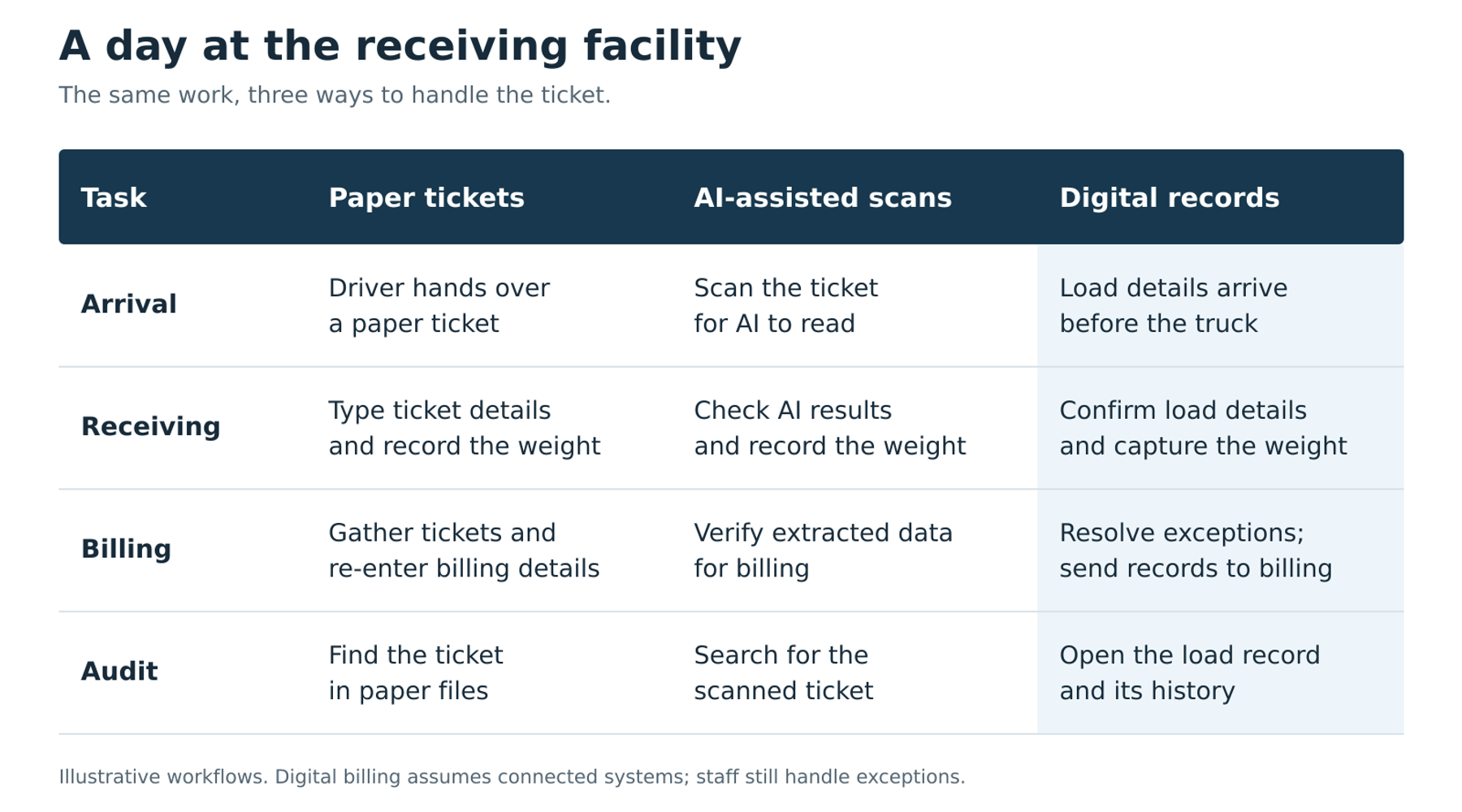
Day in the Life of Manifest Control: A Comparative View
The comparison below follows a load through a receiving facility, from arrival through billing and record keeping. It shows how the work changes when staff use paper tickets, AI to read scanned tickets, or records created digitally from the start.

The Strategic Takeaway
AI can reduce the time spent reading and typing paper tickets. Staff may still need to check the results or follow up when the original ticket is incomplete. Even with those limits, it can make an immediate difference for facilities that receive paper every day.
Creating records digitally from the start offers a further improvement. Customer and load information can be entered before arrival, checked at the scale house, and carried into billing. Staff can spend less time copying information between systems and more time handling the loads that need attention.
Making this work also means making it easy for producers and haulers to do business with the facility. They should be able to provide the required information, complete the delivery, and retrieve their tickets without extra calls or complicated steps. That makes their day easier and gives the receiving team fewer problems to sort out afterward.
I’d start with the work your staff repeats every day. Follow a few loads from arrival to billing and note where someone retypes information, fixes a mistake, or waits for a document. Those are useful places to improve first, with results you can measure in staff time and how quickly completed loads are ready to bill.
Topics